
Anniversary Reflections of CU's Role in the Aurora Theater Shooting
A Pattern of Cover-ups by CU
7/20/202612 min read
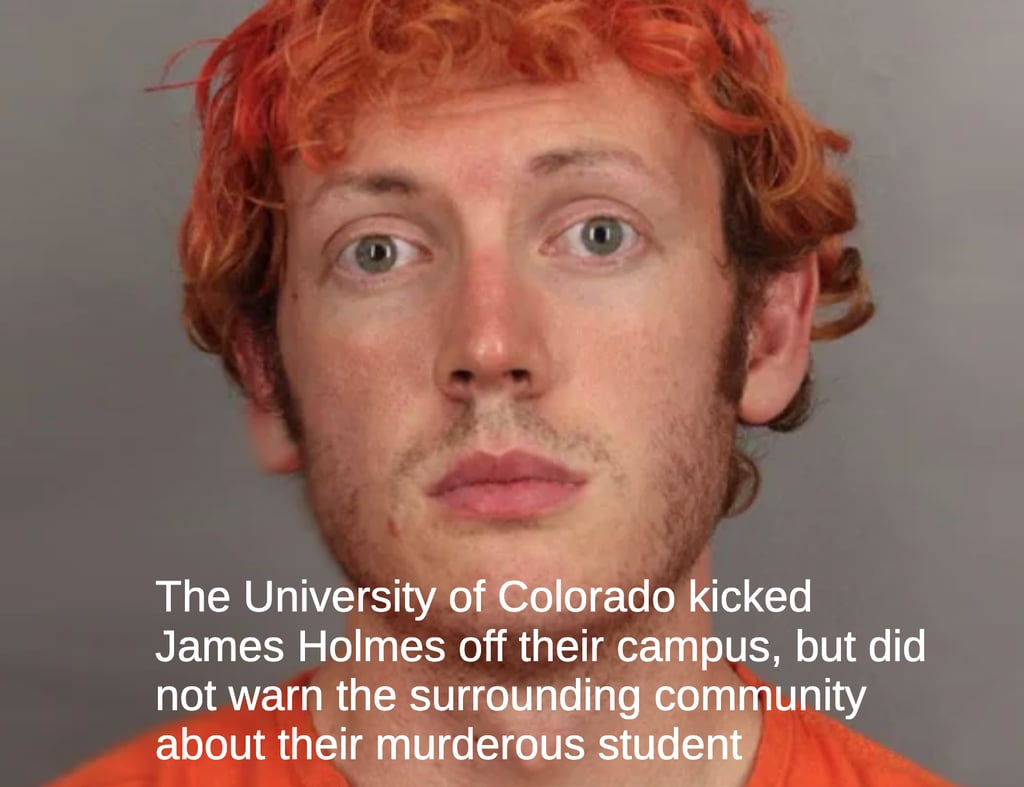
Today is the anniversary of the tragic Aurora Theater Shooting in which the University of Colorado Denver graduate student James Holmes shot 70 people, killing 12 of the victims. This tragedy could have been prevented if the University of Colorado had been transparent with law enforcement about the threats that they knew about. Instead of warning the surrounding community of the homicidal threat, CU expelled James Holmes, locked him out of their buildings, and released him into the public without oversight. Following the twelve murders and foiled bomb plot, the University of Colorado went into “cover our ass” mode. I was a faculty member at CU Denver at the time, and received an email instructing me not to speak about James Holmes or the shooting with anyone. I believe this email went to all faculty, including those who might have had useful information.
James Holmes shared his wish to kill multiple people with CU psychiatrist Dr. Lynne Fenton, who reported her concerns with the university's Behavioral Evaluation and Threat Assessment (BETA) team a full month before the theater shooting. On July 12, 2012 Holmes mailed a package to CU that contained plans and diagrams of his massacre. The package was postmarked from an Aurora post office eight days before the shooting took place, but it remains unclear why CU did not discover the package until after the shooting. CU police were aware of the threats and took action to secure the campus, but CU never shared knowledge of the threats with the surrounding community. Aurora police learned of James Holmes when they arrested him for shooting up a theater at one of the community’s malls.
A negligence lawsuit was filed by the families of the victims against the University of Colorado and its staff psychiatrist, Dr. Lynne Fenton, arguing that Dr. Fenton and CU Denver had a strict "duty to use reasonable care to protect the public". The plaintiffs alleged that because Holmes explicitly told Dr. Fenton he was fantasizing about mass slaughter, she acted negligently by turning down campus police officers' offers to put him on a 72-hour mental health hold. The lawsuit was dismissed in 2016 with no financial liability found against the university. Apparently CU’s strategy to cover their ass worked.
Learning from mistakes they made with James Holmes, the University of Colorado Denver changed the Behavioral Evaluation and Threat Assessment (BETA) team into the Faculty and Staff Threat Assessment and Response (FaST) Team on July 1, 2013. The Aurora theater shooting is just one example of how the University of Colorado will go to extraordinary lengths to cover their ass. The CUDenverLynx.com blog documents racism at CU: this publication is only possible because Prof. Greg Cronin settled his federal lawsuit against CU without including an NDA or non-disparagement clause. Nearly all lawsuits that CU settles silences the parties involved. I encourage others to follow my example of settling your suits against CU without selling your voice. Exposure to sunlight is the best disinfectant for the corruption and unethical behavior at CU. For example, it is reported here and now that the renamed threat assessment team that dropped the ball regarding James Holmes was weaponized by the Department of Integrative Biology to attack Prof. Cronin for complaining about racism. In a move akin to SWATing, Profs. Diana Tomback, Michael Greene, Bradley Stith, Charles Ferguson, and John Swallow reported Prof. Cronin to the Faculty and Staff Threat Assessment and Response (FaST) Team even though Cronin never made a threat to anybody. CU covered their ass when BETA dropped the ball with James Holmes, changed the name from BETA to FaST, and then weaponized FaST to tarnish the reputation of a faculty member who exposed racism at CU.
The hypocrisy of claiming transparency and public trust when the reality is the exact opposite is astounding, and should be exposed. For example, while CU was illegally dismissing Prof. Cronin, they sent him a “Dear Valued Community Member” letter apologizing for a data breach that exposed him to identity theft and fraud. This letter was sent about the same time that Dept. of Human Resources caused a data breach that was never reported to affected parties. The Dept. of Human Resources copied all of Prof. Cronin’s emails onto a jump-drive, placed it in a regular paper envelope, and mailed it from Denver to Waverly, KS. A postal office sorting machine ripped the jump-drive from the envelope, and its condition, location, and status remain unknown to the university. Dr. Cronin immediately reported the loss of the jump-drive to Doug Kasyon, Director of Human Resources, who notified CU attorneys. Over a decade of confidential emails are unaccounted for and could be in the hands of anybody. Thousands of confidential student records, personnel records, and university business should no longer be considered confidential. To my knowledge, this breach of data has never been reported to affected parties. Instead, CU swept it under the rug and hoped that nobody would find out about it.
It’s difficult to know how many times CU successfully covers their ass and prevents damning information from reaching the public. CU Denver’s Office of Equity routinely fails to investigate reports of discrimination citing the excuse of “there is not enough evidence”. Do idiots understand that the purpose of an investigation is to uncover evidence? The following are some examples of the lengths CU will go to when covering their ass. I asked the questions and AI responded because information was released publicly.
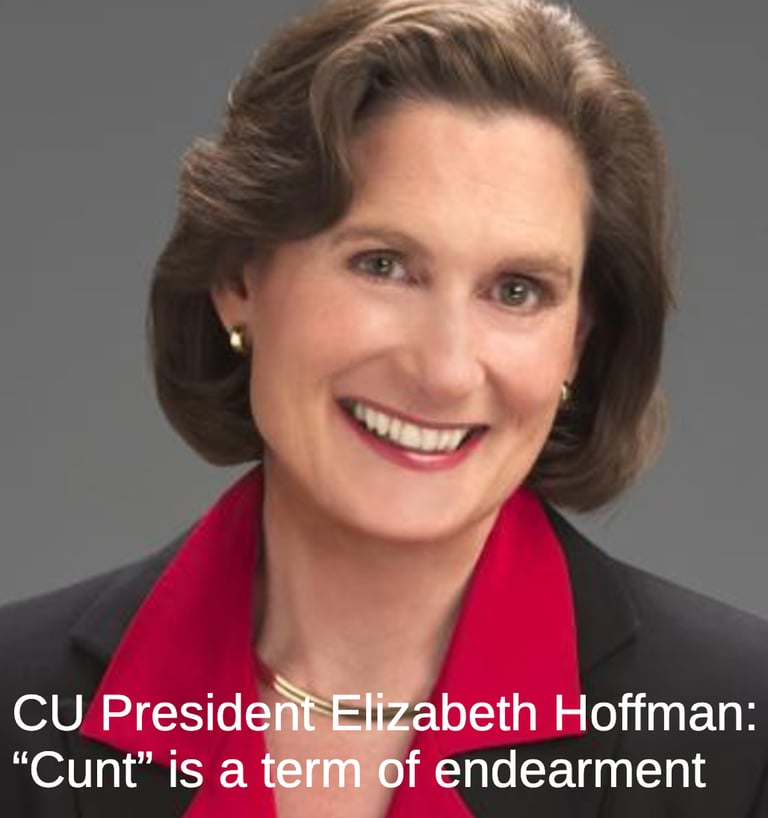
Did CU President Elizabeth Hoffman make an excuse for a female football player being called a "cunt"?
Yes, in June 2004, University of Colorado President Elizabeth Hoffman sparked intense public outrage when she testified under oath that the word "cunt" could be used as a "term of endearment". [1, 2]
The incident unfolded during a high-profile legal deposition related to the university's massive football recruiting and sexual assault scandal. [1, 2]
The Context of the Statement
The Target: Hoffman was being questioned by attorneys about former CU placeholder and kicker Katie Hnida, the first woman to score in a Division I-A football game. Hnida had reported being subjected to severe harassment, including being called the gender-based slur by her own teammates. [1, 2, 3]
The "Excuse": When asked about the use of the word on campus, Hoffman—who was a medieval scholar by academic training—attempted to contextualize the slur historically. She testified that while it is a swear word, she had also heard it used in "non-negative terms" and as a historical "term of endearment". [1, 3]
The Backlash and Apology
Hoffman's attempt to provide academic or linguistic context for a severe workplace slur was widely viewed as a tone-deaf excuse that minimized the harassment of a female student-athlete. [1, 2]
Public Outrage: State lawmakers, campus student organizations, and women's advocacy groups fiercely condemned her comments. Colorado Regent Jim Martin publicly stated that her testimony "shocks the sense of human decency". [, 2, 3]
The Retraction: Following immediate, intense blowback, Hoffman released a public statement stating, "Sorry I said it". She clarified that she considered the word "vile" and apologized for her insensitive choice of words during the deposition. [, 3]
This controversy severely damaged Hoffman's administrative credibility. It became a primary factor, alongside the broader football recruiting scandal and the Ward Churchill academic controversy, that forced her resignation as CU President less than a year later, in March 2005. [1, 2, 3, 4]
Was John Eastman, the architect of the Jan. 6 coup attempt, a faculty member at CU?
Yes, John Eastman was a faculty member at the University of Colorado Boulder during the exact period he was advising Donald Trump on overturning the 2020 election results. [1, 2]
He served as the Visiting Scholar in Conservative Thought and Policy at CU Boulder's Bruce D. Benson Center for the Study of Western Civilization for the 2020–2021 academic year. [1, 2, 3, 4]
His Role and Actions While at CU Boulder
Conducting Coup Planning on Campus: While employed by CU, Eastman used his university email account to communicate with lawmakers, coordinate legal strategies, and write the infamous memos detailing how Vice President Mike Pence could block the certification of the electoral votes. [1, 2]
The Jan. 6 Rally: While still actively contracted as a CU professor, Eastman stood on stage alongside Rudy Giuliani at the "Save America" rally on January 6, 2021, directly preceding the attack on the U.S. Capitol. [1, 2]
CU Boulder's Response and Aftermath
Following the insurrection, the university faced intense backlash and internal demands to fire him. However, the administration stated that the First Amendment legally barred them from terminating his contract over outside political speech. Instead, CU took a series of aggressive administrative actions: [1, 2, 3, 4]
Sidelined and Stripped of Duties: On January 21, 2021, the university formally stripped Eastman of his public duties, forbidding him from speaking or performing community outreach on behalf of the university. [1, 2, 3, 4]
Class Cancellations: His spring 2021 courses were canceled by the administration, which officially cited single-digit student enrollment. [1]
Contract Expiration: The university allowed his one-year appointment to naturally expire in May 2021, completely severing ties with him. CU leaders later openly called his appointment to the school "a disaster." [1, 2, 3]
Did CU break rules when they hired President Mark Kennedy?
Yes, a Colorado district court ruled that the University of Colorado Board of Regents broke state transparency laws during the 2019 hiring of President Mark Kennedy. However, that ruling was later overturned on appeal. [1, 2]
The controversy centered on whether the university used "linguistic gymnastics" to skirt state open-records requirements and hide the identity of other applicants. [1]
The Rules CU Was Accused of Breaking
The Boulder Daily Camera sued the CU Board of Regents, alleging they violated the Colorado Open Records Act (CORA) and the Colorado Open Meetings Law. [1, 2]
Hiding the "Finalists": State law required public universities to disclose the names and application materials of all "finalists" under consideration for a chief executive position at least 14 days before making an appointment. [1]
The Loophole: The search committee narrow-downed the pool to six candidates, all of whom were interviewed by the Board of Regents. To avoid making those six names public, the Regents voted to declare Mark Kennedy as the sole "finalist," withholding the other five names from the public and the media. [1, 2]
The Court Rulings
The Initial Verdict (Violation Found): In March 2020, Denver District Court Judge A. Bruce Jones ruled heavily against the university. He stated that under the plain meaning of the law, all six interviewed individuals were realistically "finalists". The judge criticized CU's defense as a hollow attempt to "justify a pre-determined outcome, rather than to align with the statutes" and ordered the university to release the names. [1]
The Reversal (Legally Cleared): CU appealed the decision. The Colorado Court of Appeals eventually reversed the ruling, concluding that because the regents technically only advanced one person to the absolute final stage, they did not violate the letter of the law. The Colorado Supreme Court declined to review the case, letting the university off the hook legally. [1, 2]
The Aftermath
While CU technically won the legal battle on a narrow statutory interpretation, the secret process deeply damaged trust across the university system. Kennedy's hiring proceeded on a highly contentious, 5–4 partisan split vote. [1]
Faced with continuous faculty censures, student government reprimands, and widespread backlash over the hiring process, Kennedy's tenure was brief. He stepped down in 2021 after serving just two years. The transparency loophole exposed by his hiring was so glaring that the Colorado Legislature later stepped in to pass new legislation clarifying how public bodies can name a single finalist.
Why did Mark Kennedy leave CU?
Mark Kennedy left the University of Colorado on July 1, 2021, following a forced ouster triggered by a political shift on the Board of Regents and severe backlash over his handling of diversity initiatives. [1, 2]
Because his exit was effectively a forced resignation negotiated a year before his contract expired, CU paid Kennedy a $1.36 million severance settlement. [1]
His departure was driven by two main factors:
1. A Shift in Political Power on the Board
Kennedy, a conservative former Republican congressman, was hired in 2019 on a contentious 5–4 party-line vote by a Republican-led Board of Regents. However, in January 2021, the political landscape shifted when Democrats won a majority on the board for the first time in 40 years. [1, 2]
The new board majority made it clear they did not share Kennedy's "focus and philosophy". Seeing the writing on the wall, Kennedy entered negotiations to exit, while Republican regents openly complained that the new majority was "firing" him solely for his political alignment. [1, 2]
2. Faculty and Student Censures Over Diversity
Kennedy’s brief tenure was plagued by constant friction with the campus community over diversity, equity, and inclusion (DEI). The breaking point occurred in early 2021 after a string of perceived missteps: [1, 2, 3]
The "Trail of Tears" Comment: During a 2020 faculty meeting discussing the growth of online education, Kennedy remarked, "If we don't get online right… we have a trail of tears in front of us." Using a historical tragedy that resulted in the forced march and deaths of thousands of Native Americans as a corporate metaphor sparked intense outrage. [1]
Official Censures: In March 2021, the CU Boulder Faculty Assembly voted overwhelmingly to censure Kennedy for a "failure of leadership with respect to diversity". In April 2021, the CU Boulder student government followed suit with their own censure vote. [1, 2]
Why did Jeffrey Beall "retire" from CU?
Jeffrey Beall "retired" from CU Denver because he felt the university’s administration created an intentionally hostile work environment to force him out. [1, 2]
While his official departure was processed as a voluntary retirement, Beall publicly maintained that he was facing "intense pressure" from his employer and was effectively forced out to protect the university from corporate legal liability. [1, 2, 3]
The specific compounding factors that drove his decision to retire include:
1. The Threat of Job Termination
After Beall added the major open-access publisher Frontiers Media to his blacklist in 2015, the company heavily lobbied CU Denver to take punitive action against him. Beall stated that university administrators shifted from supporting him to viewing his list as an existential administrative headache. He later wrote that he ultimately killed the project and left academia because he was "fearing for my job". [1, 2, 3, 4]
2. Retaliatory Workplace Harassment
Beall alleged that CU Denver attempted to make his day-to-day employment as miserable as possible to trigger his resignation. According to Beall, the university took several retaliatory steps: [1, 2]
Placing an "unqualified, mendacious supervisor" over him who constantly monitored and attacked his actions.
Stripping away his office and restricting him to a small cubicle usually reserved for student workers.
Isolating him from library operations and threatening his overall job security. [1, 2]
3. Exhaustion from Institutional Betrayal
The final straw for Beall was the university's decision to capitulate to corporate demands and launch a seven-month research misconduct investigation against his blog. Even though the investigation closed with no findings of misconduct and completely cleared his name, Beall felt the university’s willingness to put his academic freedom on trial made it impossible to safely continue his career there. [1]
CU Denver's Counter-Stance
The university has consistently denied Beall’s version of events. In official statements, CU Denver spokespeople maintained that taking down the blacklist was entirely Beall's personal choice and publicly disagreed with his assertions of workplace harassment or administrative pressure. [1, 2, 3]
The University of Colorado (CU) system faces ongoing criticism, formal complaints, and campus protests over its racial climate, though the institution explicitly maintains an anti-racist stance and funds diversity initiatives. [1, 2, 3]
While the university administration publicly commits to inclusivity, Black student groups, faculty members, and external reports have repeatedly alleged that institutional practices and a lack of representation foster an unwelcoming, and at times hostile, environment for Black individuals. [1, 2, 3, 4]
The primary factors driving the debate regarding whether CU has systemic issues with anti-Black racism include:
1. The 2023 "Shadow Report" on Faculty of Color
In September 2023, graduate students at CU Boulder published a highly publicized "Shadow Report" detailing a hostile racial environment within the School of Education. The document accused the university of an enduring history of "rampant and unbridled anti-blackness," alleging that systematic bullying, microaggressions, and surveillance pushed out four female tenure-track faculty members of color—specifically Black women professors. In response, the Dean of the School of Education acknowledged the report and stated that higher education institutions have historical legacies of racism, admitting, "we at CU Boulder and in the School of Education are no exception." [1, 2, 3]
2. Extremely Low Black Representation
Critics frequently point to demographic data to argue that the university system lacks a meaningful commitment to diversity. For example, at CU Boulder's undergraduate campus, Black and African American students make up less than 3% of the total student body. This demographic isolation often leaves Black students reporting feelings of hyper-surveillance and alienation in overwhelmingly white spaces. [1, 2, 3]
3. High-Profile Racial Incidents and Activism
The university has been a frequent site of student-led protests regarding how administration handles overt racism on campus: [1, 2]
Overt Slurs on Campus: In 2019, a viral video showed an unaffiliated person entering a campus study lounge and screaming anti-Black slurs at students. The Black Student Alliance and other campus organizations launched major protests, demanding faster disciplinary responses and more rigorous anti-discrimination frameworks. [1]
Free Speech vs. Hate Speech Friction: Student activists have consistently expressed frustration that the administration frequently cites First Amendment legal obligations—due to CU being a public entity—as a reason they cannot immediately expel or fire individuals who post explicitly racist or harmful rhetoric online. [1]
It is clear that CU administrators will say anything, break laws, and deploy bullying tactics to cover their ass. Coloradoans should demand independent investigation into university business, rather than allowing CU to hire investigators that are beholden to them. Institutions investigate themselves when they have things to hide. I have witnessed the sleazy, bullying tactics of CU administration, and will continue to report on them here. If you want to publish information about the University of Colorado, please email EndRacismAtCU@gmail.com. CUDenverLynx.com is committed to publishing accurate stories about CU while protecting the identity of parties.
CUDenverLynx.com's goal is to shine disinfecting light on racism at the University of Colorado. This Blog exercises freedom of the press and strives to disseminate accurate information in this public forum. Inquiries can be made to Chancellor@CUDenverLynx.com. Story ideas about racism at CU or higher education should be sent to EndRacism@CUDenverLynx.com.